


偏微分方程(Partial Differential Equations)
一、偏微分方程课程定位
偏微分方程课程全面介绍偏微分方程基本知识。本课程要求学生理解二阶线性偏微分方程的分类,偏微分方程的边值问题和初值问题的提法,掌握求解位势方程的边值问题、热方程和波动方程的初值问题和初边值问题的基本方法和位势方程、热方程和波动方程的基本理论。课程为学生学习偏微分方程的研究生课程和与偏微分方程相关的后续课程打下坚实基础。
二、 偏微分方程课程目标
偏微分方程课程以培养学生建立、理解、分析、求解偏微分方程并用于解决实际问题的能力为目标,重点介绍三类经典的二阶线性偏微分方程的基本方法和基础理论。这三类方程分别为位势方程、热方程和波动方程。利用基本解和Green函数求解位势方程的边值问题和热方程的初边值问题,利用Fourier变换求解热方程及波动方程的初值问题,利用分离变量法求解热方程和波动方程的初边值问题,利用特征线法、球平均法和降维法求解一维、二维和三维波动方程初值问题。同时讲解位势方程和热方程的极值原理和最大模估计,波动方程的能量不等式等等。
三、 偏微分方程课程设计
偏微分方程课程重点介绍三类经典的二阶线性偏微分方程:位势方程、热方程和波动方程。偏微分方程课程分成四个部分。第一部分介绍偏微分方程的术语和准备知识,第二部分介绍位势方程的基本方法和基础理论,第三部分介绍热方程的基本方法和基础理论,第四部分介绍波动方程的基本方法和基础理论。
第一部分包括偏微分方程的基本概念、二阶线性偏微分方程的分类、偏微分方程的边值问题和初值问题及其适定性问题。
第二部分介绍位势方程的基本方法和基础理论。重点介绍调和函数及其性质,位势方程的基本解和如何使用基本解来构造位势方程边值问题的Green 函数, 进而得到位势方程边值问题解的表达式。然后介绍位势方程最重要的先验估计——极值原理和最大模估计。另外,还介绍位势方程的能量模估计。
第三部分介绍热方程的基本方法和基础理论。重点介绍Fourier变换方法和分离变量法。利用Fourier变换方法求出热方程初值问题解的表达式, 并得到热方程的基本解。利用分离变量法来解出一维热方程的初边值问题解的表达式, 并得到热方程相应问题的Green 函数。然后介绍关于热方程的初边值问题和初值问题的极值原理和最大模估计。另外,还介绍热方程的能量模估计。
第四部分介绍波动方程的基本方法和基础理论。重点介绍特征线法、球平均法和降维法, 利用这些方法求解出一维、二维和三维波动方程初值问题解的表达式。然后介绍波动方程重要的概念——特征线(特征锥), 推导波动方程基本的先验估计——能量不等式。利用分离变量法求解出一维波动方程初边值问题问题解的表达式, 然后推导相应的能量不等式。
知识点 |
主要内容 |
能力目标 |
学时 |
基本概念 |
定义和实例 |
了解重要的偏微分方程和方程组。 |
1 |
分类和适定性 |
二阶线性偏微分方程的分类、 边值问题和初值问题的提法、适定性问题 |
了解二阶线性偏微分方程的分类和理解适定性问题的重要性。 |
2 |
知识点 |
主要内容 |
能力目标 |
学时 |
位势方程的推导 |
变分模型、扩散模型、概率模型 |
理解位势方程的来源及边值问题。 |
2 |
调和函数 |
调和函数的性质 |
学会调和函数的平均值公式,各阶偏导数的估计,推导Liouville性质,Harnack不等式,调和函数的解析性等。 |
6 |
基本解和Green 函数 |
基本解的含义和Green 函数的构造 |
学会如何使用基本解来构造位势方程边值问题Green 函数, 并得到位势方程的边值问题解的表达式,从而解决位势方程的边值问题解的存在性。 |
4 |
极值原理和最大模估计 |
极值原理,Hopf引理和各种边值问题的最大模估计 |
学会极值原理的证明方法,学会利用极值原理来证明各种边值问题的最大模估计,理解位势方程边值问题解的唯一性和稳定性。 |
3 |
能量模估计 |
能量模估计的形式 |
学会能量模估计的证明方法,理解能量模估计和最大模估计的优点和差异。 |
1 |
部分3:热方程(13学时)
知识点 |
主要内容 |
能力目标 |
学时 |
热方程的推导 |
扩散模型 |
理解热方程的来源及初值问题和初边值问题。 |
1 |
初值问题 |
Fourier变换、Fourier逆变换和Fourier积分定理 |
学会从Fourier级数导出Fourier变换、Fourier逆变换和证明Fourier积分定理。 |
4 |
初值问题的热核和基本解 |
热核的表达式和基本解的含义 |
学会如何利用Fourier变换方法求出热方程初值问题解的表达式,并由此得到热方程的基本解,理解热方程具有扰动无穷传播速度和光滑化效应的特性。 |
2 |
初边值问题的Green函数 |
特征值问题、分离变量法 |
学会如何利用分离变量法来解出一维热方程的初边值问题解的表达式,得到热方程相应问题的Green 函数。理解初边值问题解的存在性。 |
2 |
极值原理和最大模估计 |
极值原理和各种最大模估计 |
学会热方程极值原理的证明方法,学会利用极值原理来证明各种初边值问题的最大模估计及初值问题的最大模估计,理解相应问题的解的唯一性和稳定性。 |
3 |
能量模估计 |
能量模估计的形式 |
学会能量模估计的证明方法,理解能量模估计和最大模估计的优点和差异。 |
1 |
部分4:波动方程(16学时)
知识点 |
主要内容 |
能力目标 |
学时 |
波动方程的推导 |
弦振动模型、薄膜模型、弹性体模型,Duhamel原理 |
理解波动方程的来源及初值问题和初边值问题,简化波动方程的初值问题的求解。 |
2 |
初值问题 |
特征线方法、球平均方法和降维法 |
学会利用特征线方法、球平均方法和降维法求出一维、二维和三维波动方程初值问题的解的表达式,得到d’Alembert公式,Kirchhoff公式和Poisson公式。 |
5 |
特征线(特征锥) |
特征线(特征锥)的含义 |
由d’Alembert公式,Kirchhoff公式和Poisson公式,理解特征锥的概念和波动方程具有扰动有限传播速度的特性。 |
2 |
初值问题的能量不等式 |
能量不等式的含义和表达式 |
理解波动方程初值问题的能量不等式,学会推导波动方程初值问题的能量不等式,理解相应问题的解的唯一性和稳定性。 |
3 |
波动方程初边值问题 |
特征值问题、分离变量法 |
学会如何利用分离变量法来解出一维波动方程初边值问题解的表达式,理解其物理意义。 |
2 |
初边值问题的能量不等式 |
能量不等式的含义和表达式 |
理解波动方程初边值问题的能量不等式,学会推导波动方程初边值问题的能量不等式,理解相应问题的解的唯一性和稳定性。 |
2 |
偏微分方程课程共需48学时。
四、 偏微分方程课程知识点
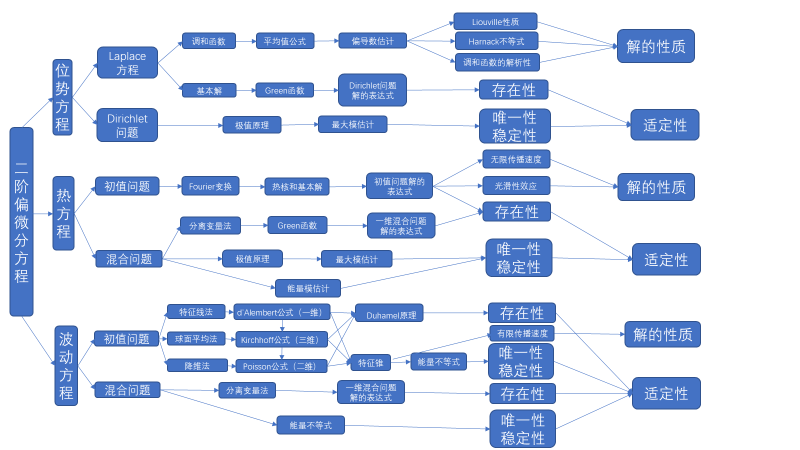
上述知识点形成如下布局及思维导图:
五、 偏微分方程课程英文摘要
1、 Course orientation for PDE
The course comprehensively introduces the preliminary knowledge of partial differential equations. Students are required to understand the classification of second order linear partial differential equations, and the formulation of the boundary problems and the initial value problems of partial differential equations, and to master the elementary methods of solving the boundary value problems of the potential equations, the initial value problems and initial-boundary problems of the heat equations and the wave equations, and the fundamental theory of the potential equations, the heat equations and the wave equations. This course will lay a solid foundation for the students to learn the graduate courses of partial differential equations and successive courses related to partial differential equations.
2、 Course objectives for PDE
The course aims to cultivate students' ability to establish, understand, analyze, and calculate the partial differential equations for solving the practical problems. The course mainly introduces the elementary methods and the fundamental theory of three classical types of second order linear partial differential equations, which are the potential equations, the heat equations and the wave equations. We will use the fundamental solutions and Green functions to find the solutions of the boundary value problems of the potential equations and the initial-boundary problems of the heat equations. We will employ the Fourier transform to find the solutions of the initial value problems of the heat equations and the wave equations. We will apply the method of separation of variables to obtain the solutions for the initial-boundary problems of the heat equations and wave equations. We will utilize the methods of the characteristic lines, the spherical means and descent to find the solutions of one-, two- and three-dimensional initial value problems of the wave equations. We will introduce the maximum principles and the maximum norm estimates of the potential equations and the heat equations, and the energy inequalities of the wave equations, etc.
3、 Course design for PDE
In this course we emphatically introduce three classical types of second order linear partial differential equations, which are the potential equations, the heat equations and the wave equations. This course is divided into four parts. In Part 1 we will introduce the notation and some preliminary materials of partial differential equations. In Part 2 we introduce the elementary methods and the fundamental theory of the potential equations. In Part 3 we introduce the elementary methods and the fundamental theory of the heat equations. In Part 4 we introduce the elementary methods and the fundamental theory of the wave equations.
Part 1 consists of the basic concepts of partial differential equations, the classification of second order linear partial differential equations, the formulation and the well-posedness of the boundary problems and initial-boundary problems of the partial differential equations.
In Part 2 we introduce the elementary methods and the fundamental theory of the potential equations. We emphatically introduce the harmonic functions and their properties, the fundamental solutions and how to use them to construct the Green functions of the boundary value problems of the potential equations, and then find the explicit formulas of the solutions of the corresponding the boundary problems. Later we introduce the maximum principles and the maximum norm estimates, which are the most important a priori estimates of the potential equations. Moreover, we will introduce the energy norm estimates of the potential equations.
In Part 3 we introduce the elementary methods and the fundamental theory of the heat equations. We emphatically introduce the methods of the Fourier transform and separation of variables. We employ the Fourier transform to obtain the explicit formulas of the solutions for the initial value problems of the heat equations, and the fundamental solutions of the heat equations. We utilize the method of separation of variables to obtain the explicit formulas of the solutions and the Green functions for the initial-boundary problems of the one-dimensional heat equations. Later we introduce the maximum principles and the maximum norm estimates for the initial-boundary problems and the initial value problems of the heat equations. Moreover, we will introduce the energy norm estimates of the heat equations.
In Part 4 we introduce the elementary methods and the fundamental theory of the wave equations. We emphatically introduce the methods of the characteristic lines, the spherical means and descent to obtain the explicit formulas of the solutions for the one-, two- and three-dimensional initial value problems of the wave equations. Then we introduce an important concept of the wave equations, which is the characteristic lines(cones), and deduce the energy inequalities, which are the fundamental a priori estimates of the wave equations. Later we utilize the method of separation of variables to obtain the explicit formulas of the solutions for the initial-boundary problems of the one-dimensional wave equations and deduce the corresponding energy inequalities.
Topic |
Contents |
Goals |
Hours |
Basic concepts |
Definitions and examples |
Be aware of important partial differential equations and systems. |
1 |
Classification and well-posedness |
Classification of second order linear partial differential equations, the formulation and well-posedness of the boundary problems and initial-boundary problems |
Be aware of classification of second order linear partial differential equations and understand the importance of the well-posedness. |
2 |
Part 2:The Potential Equations (16 hours)
Topic |
Contents |
Goals |
Hours |
Deduction of the potential equations |
Variational model, diffusion model and probability model |
Understand the origin and boundary problems of the potential equations. |
2 |
Harmonic functions |
Properties of harmonic functions |
Know the mean value formula and the estimates of partial derivatives and deduce Liouville theorem, Harnack inequality and analyticity of harmonic functions. |
6 |
Fundamental solutions and Green functions |
The meaning of fundamental solutions and the construction Green functions for boundary problems of the potential equations |
Know how to use fundamental solutions to construct the Green functions and obtain the explicit formulas of solutions, and then solve the existence of boundary problems of the potential equations. |
4 |
Maximum principles and maximum norm estimates |
Maximum principles, Hopf lemma and maximum norm estimates of different types of boundary problems of the potential equations |
Know the method to prove maximum principles and how to use them to prove maximum norm estimates and comprehend the uniqueness and stability of the solutions for some boundary problems of the potential equations. |
3 |
Energy norm estimates |
Energy norm estimates |
Know the method to prove energy norm estimates and understand the advantage and difference of maximum norm estimates and energy norm estimates. |
1 |
Part 3:The Heat Equations (13 hours)
Topic |
Contents |
Goals |
Hours |
Deduction of the heat equations |
Diffusion model |
Understand the origin, and the initial value problems and the initial-boundary problems of the heat equations. |
1 |
Initial value problems |
Fourier transform, Fourier inverse transform and Fourier integral theorem |
Know how to deduce Fourier transform from Fourier series and how to prove Fourier integral theorem. |
4 |
Heat kernels and Fundamental solutions |
The explicit formulas of heat kernels and the meaning of fundamental solutions |
Know how to deduce the explicit formulas of the initial value problems of the heat equations by using the method of Fourier transform and obtain the fundamental solutions and understand heat equations have such features as infinite propagation speed of perturbation and regularizing effect. |
2 |
Green functions |
Eigenvalue problems and separation of variables |
Know how to deduce the explicit formulas of the initial-boundary problems of the one-dimensional heat equations by using the method of separation of variables and obtain the Green functions of the corresponding problems. And comprehend the existence of solutions of the corresponding problems. |
2 |
Maximum principles and maximum norm estimates |
Maximum principles and maximum norm estimates of different types |
Know the method to prove maximum principles and how to use them to prove maximum norm estimates of initial-boundary problems and initial value problems of the heat equations, comprehend the uniqueness and stability of the solutions for some initial-boundary problems of the potential equations. |
3 |
Energy norm estimates |
Energy norm estimates |
Know the method to prove energy norm estimates and comprehend the advantage and difference of maximum norm estimates and energy norm. |
1 |
Part 4:The Wave Equations (16 hours)
Topic |
Contents |
Goals |
Hours |
Deduction of the wave equations |
String vibration model, thin film model and elasticity body model, Duhamel's principle |
Understand the origin, and the initial value problems and the initial-boundary problems of the wave equations and simplify the process to find solutions of initial value problems of the wave equations. |
2 |
Initial value problems |
Methods of the characteristic lines, the spherical means and descent |
Know the methods of the characteristic lines, the spherical means and descent to obtain the explicit formulas of the solutions for the one-, two- and three-dimensional initial value problems of the wave equations and obtain d’Alembert’s formula, Kirchhoff’s formula and Poisson’s formula. |
5 |
Characteristic lines (cones) |
The meaning of characteristic lines (cones) |
Deduce the characteristic cones from d’Alembert’s formula, Kirchhoff’s formula and Poisson’s formula, and understand that the wave eqautions have a finite propagation speed of perturbation. |
2 |
Energy inequalities of initial problems |
The formulation of energy inequalities |
Understand energy inequalities, know how to deduce them, comprehend the uniqueness and stability of the solution of the corresponding problems. |
3 |
Initial-boundary problems |
Eigenvalue problems and separation of variables |
Know how to deduce the explicit formulas of the initial-boundary problems of the one-dimensional wave equations by using the method of separation of variables and understand its physical meaning. |
2 |
Energy inequalities of initial problems |
The formulation of energy inequalities |
Understand energy inequalities, know how to deduce them, comprehend the uniqueness and stability of the solution of the corresponding problems. |
2 |
This course needs 48 teaching hours.